
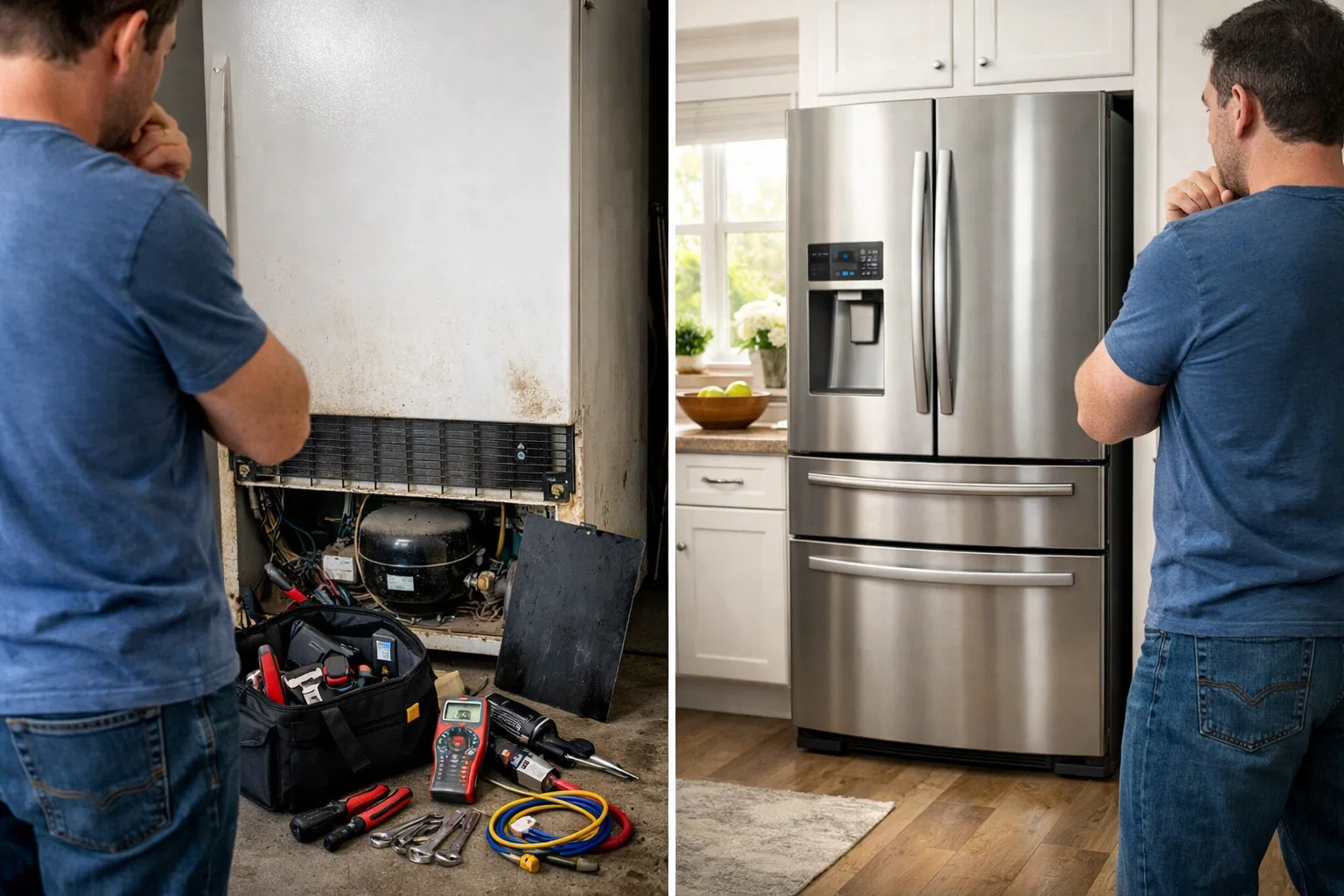
It won’t be a lie if we say that the refrigerator is the backbone of your kitchen. It protects your snacks, keeps your mom’s food fresh, your drinks cold, and your kitchen running smoothly. Unfortunately, it can’t last forever. After all, it is an appliance. You start to notice strange noises, warm spots, or higher energy bills. You don’t know if repairing is the right choice or replacing it altogether. Knowing when to choose repair vs replace a refrigerator can save you money.
What’s So Confusing About Repair vs Replace Refrigerator Decisions
Many homeowners struggle when deciding between repair vs replace refrigerator options. It is not always easy to tell when a simple fix will do the job or when continuing to repair the fridge will only cost you more in the long run. Some issues look scary but are easy to fix. Other times, a fridge looks fine but is slowly draining your wallet with energy use or constant breakdowns. Understanding the difference helps you avoid wasting money on the wrong option.
Let’s Help You Reach a Decision
There are a few things to keep in mind when your fridge breaks down again. Don’t be foolish to keep repairing a broken fridge. However, don’t be so fast in buying a new one either.
Let’s discuss all the things worth considering when deciding between repair vs replace:
Age of Your Refrigerator
A fridge’s age is one of the biggest clues. Modern refrigerators last only 10 to 15 years.
If your fridge is still young
Let’s say it is under 8 years old. Repairs are usually worth it. Parts are easier to find, and the appliance still has a lot of life left.
If your fridge is more than 12 years old
Repair vs replace refrigerator choices lean toward replacing it. Older refrigerators break down more and use more electricity. They secretly increase your monthly bills.
Quick tip: Check the serial number inside your fridge door to find its age.
Cost of the Repair
| A good rule many experts use is the 50% rule: If a repair costs more than half the price of a new fridge, it is smarter to replace it. |
Let’s understand this rule with an example:
If a new fridge costs $1,000 and your repair estimate is $600, → Replacement makes more financial sense.
Small repairs like fixing a door seal or replacing a thermostat are usually affordable. But big repairs, such as replacing a compressor, cost hundreds of dollars and may not be worth it for an older fridge.
Energy Efficiency
Your electricity bill has been creeping up for no reason? Your fridge might be the reason. Older refrigerators use more energy. That means you are paying extra money every month without realizing it. In that case, when choosing between repair vs replace refrigerator decisions, replacing the fridge can save you money over time. Remember, newer models save electricity and keep your home more energy-efficient.
How It is Working
You can learn a lot from your fridge simply by watching how it behaves. The symptoms can help you decide between repair vs replace.
Let’s summarize it through a table:
| REPAIR YOUR FRIDGE | REPLACE YOUR FRIDGE |
| Food is not cooling food as it should | The motor runs loudly all the time |
| The freezer has frost buildup | The temperature keeps changing by itself |
| The fridge is leaking water | You have repaired it multiple times in a single year |
| strange noises coming from the back | The refrigerator feels hot on the outside |
Your Future Needs
Sometimes, the decision is not just about repair vs replace refrigerator costs. It is also about what works best for your home.
If your family has grown → you need a bigger fridge.
If you changed your kitchen style → you want something more modern.
If you are planning to stay in your house for a long time → investing in a new fridge makes more sense.
Food Safety
A fridge that does not keep food cold enough can cause food to spoil faster. That means wasted groceries and possible health risks. Replacing it becomes a safety priority if your refrigerator can’t maintain a steady temperature. Food should always stay at 40°F or colder. If your fridge struggles to stay cool, that’s a strong sign it is time to upgrade.
To Summarize
The repair vs replace refrigerator problems do not feel so confusing after you consider a few important things. Start by checking your fridge’s age, looking at repair costs, and paying attention to how well it works. Think about energy efficiency and your future needs, too. Sometimes a simple repair is all you need. Other times, replacing the fridge is the money-saving choice. When you understand the signs, you can make a decision that keeps your food cold and your wallet happy.
FAQ
Is it worth fixing a 17-year-old refrigerator?
No, it is not worth fixing a 17-year-old refrigerator. It is usually more economical to replace it with a new model that comes with a warranty.
How do I know if my fridge is dying?
Signs include food spoiling quickly, excessive condensation, the motor being very noisy, and the back of the fridge feeling excessively hot.
How often should a fridge be cleaned?
You should do a thorough interior cleaning every three months.
Is it better to keep a fridge full or empty?
It is more energy-efficient to keep a fridge relatively full (around 70-80% capacity).
What shortens the life of a refrigerator?
Not cleaning the condenser coils, blocking airflow, and frequently leaving the door open are all things that shorten a refrigerator’s life.